
Music-to-dance · 14B
Wan-Dancer
Minute-scale coherent dance video from music, reference image, and style prompts.
Hierarchical framework from Tongyi Lab that breaks the ~20s diffusion barrier — stable 720p / 30fps clips over one minute across five dance genres.
Mingyang Huang · Peng Zhang · Li Hu · Guangyuan Wang · Bang Zhang
Tongyi Lab, Alibaba Group · arXiv:2607.09581 · Apache 2.0
K-pop "Radio" — outfit change · 42s
K-pop "Golden" · 2 min 36s
- Parameters
- 14B
- Output
- 720p / 30fps
- Duration
- 1+ min
- Genres
- 5 styles
Abstract
Beyond the 20-second barrier
Generating long-duration, high-definition, and rhythmically synchronized dance videos directly from music remains a significant challenge, primarily due to the temporal constraints of current diffusion models, which typically fail beyond 20 seconds. Existing approaches, whether they rely on intermediate 3D skeletons or on end-to-end video synthesis, suffer from temporal drift, identity inconsistency, and repetitive motion patterns when extended to longer horizons. To address these limitations, we propose a novel hierarchical framework for minute-scale coherent music-to-dance generation. Our method decouples the process into global keyframe planning and local temporal refinement, leveraging full-track musical context to ensure long-range coherence. Key innovations include dynamic frame rate adaptation via time-mapped RoPE embeddings for precise alignment, an optical-flow-based loss function to enhance motion continuity, and motion-speed control to preserve high-fidelity details during rapid movements. Extensive experiments demonstrate that our framework surpasses the conventional duration barrier, generating stable, 720p/30fps videos exceeding one minute with superior temporal stability. Furthermore, the model exhibits robust versatility across five distinct dance genres, conditioned on both audio and textual prompts, establishing a new state-of-the-art in coherent, long-form dance video synthesis.
Key ideas
Hierarchical generation
Global keyframe planning captures full-track musical structure, then local refinement produces high-resolution motion with long-range coherence.
Time-mapped RoPE
Dynamic frame-rate adaptation aligns dance motion to musical timing beyond the typical 20-second diffusion limit.
Optical-flow continuity
An optical-flow-based loss stabilizes motion across minute-scale sequences and reduces temporal drift.
Motion-speed control
Preserves high-fidelity detail during rapid movements instead of smearing or collapsing into repetitive patterns.
How it works
Two-stage hierarchical pipeline
Global planning locks musical structure; local refinement delivers high-resolution motion without identity collapse.
Global keyframe video
Plan the full choreography from music + reference image + style prompt, using the entire musical context.
Local high-res refinement
Condition on the global video to generate the final 720p/30fps clip with tight rhythm and identity consistency.
Showcase
Generated results from the paper
All demo clips from the official project page and Wan-Dancer-14B model card — music + reference image → dance video.
Wan-Dancer-14B pipeline samples
Final high-resolution outputs from the Hugging Face model card (5 genres).
Chinese Classical Dance
Street Dance
K-Pop Dance
Latin Dance
Tap Dance
Five dance genres
One model covers Chinese classical, K-pop, street, tap, and Latin. Each clip is already a split-screen comparison (left: reference · right: generated).
Chinese Classical Dance
Example 1
Example 2
Minute-scale music-to-dance
Stable generation past the conventional ~20s diffusion barrier — multi-minute clips at 720p / 30fps. Split-screen: left reference · right generated.
Long-form coherence
Latin dance · 2 min 8s
Chinese classical · 2 min 41s
Customized choreography (LoRA)
Low-Rank Adaptation steers the model toward specific choreographic motions while keeping identity stable. Split-screen: left reference · right generated.
Single music · multiple references — "Victory Dance"
Same track, different reference identities.
Example 1
Example 2
Example 3
Example 4
Single reference · multiple music
Tracks: "Dao Ma", "Spaghetti", "Miniskirt", "Zoo".
Example 1
Example 2
Example 3
Example 4
Diversity
Swap music, identity, or seed — the model keeps rhythm while exploring different motion paths. Split-screen: left reference · right generated.
Single reference · multiple music
Same identity, different tracks.
Example 1
Example 2
Example 3
Example 4
Example 5
Example 6
Example 7
Example 8
Single music · multiple references
Same track, different identities.
Example 1
Example 2
Example 3
Example 4
Example 5
Example 6
Example 7
Example 8
Single music · single reference · different seeds
Same inputs, diverse motion realizations.
Seed 1
Seed 2
Seed 3
Seed 4
Seed 5
Seed 6
Seed 7
Seed 8
Seed 9
Seed 10
Creative keyframe control
Edit global-stage keyframes for outfit changes, or supply motion keyframes for tightly controlled movement.
Outfit change
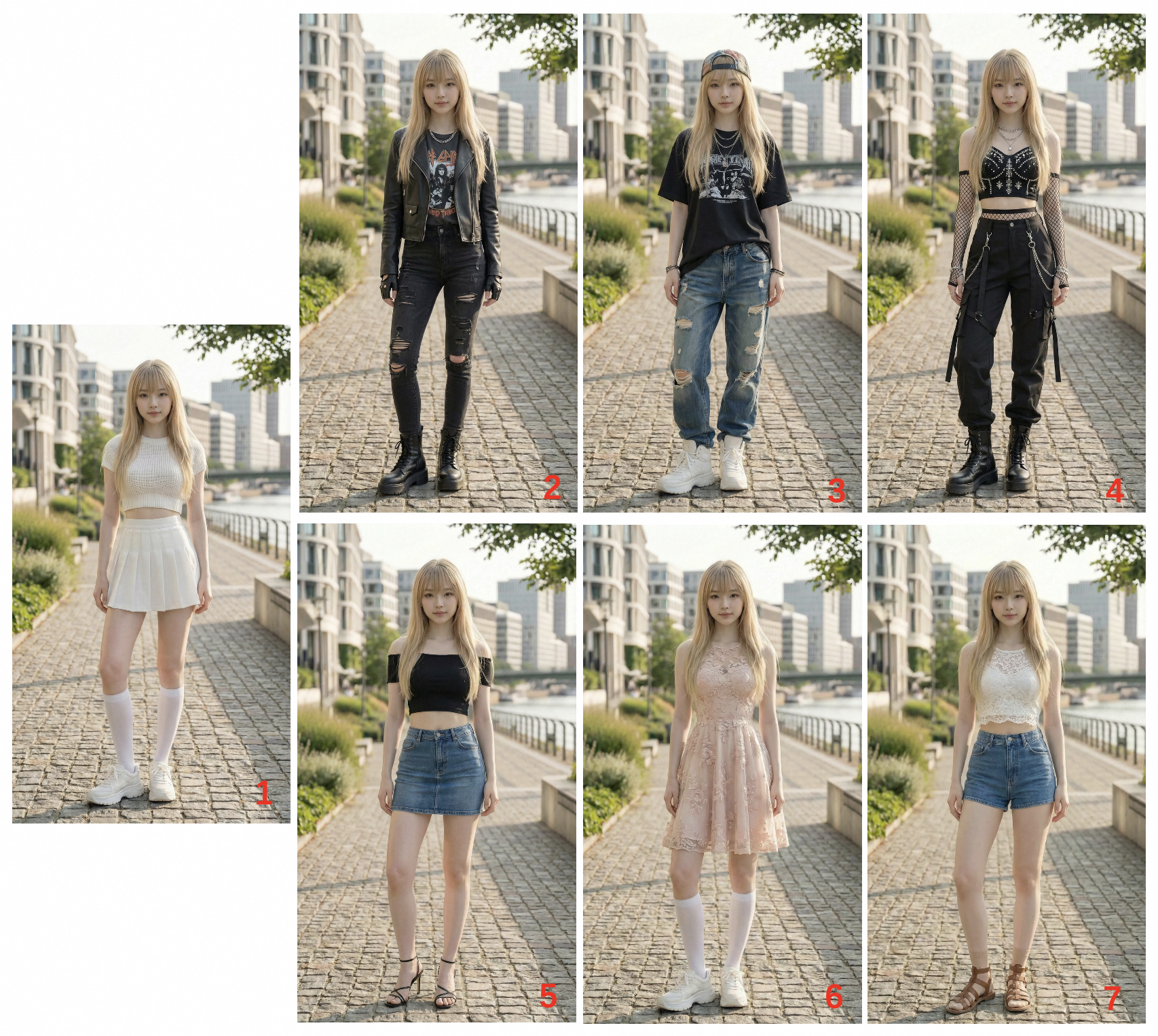
Keyframes (outfit edit)
Generated result
Movement control
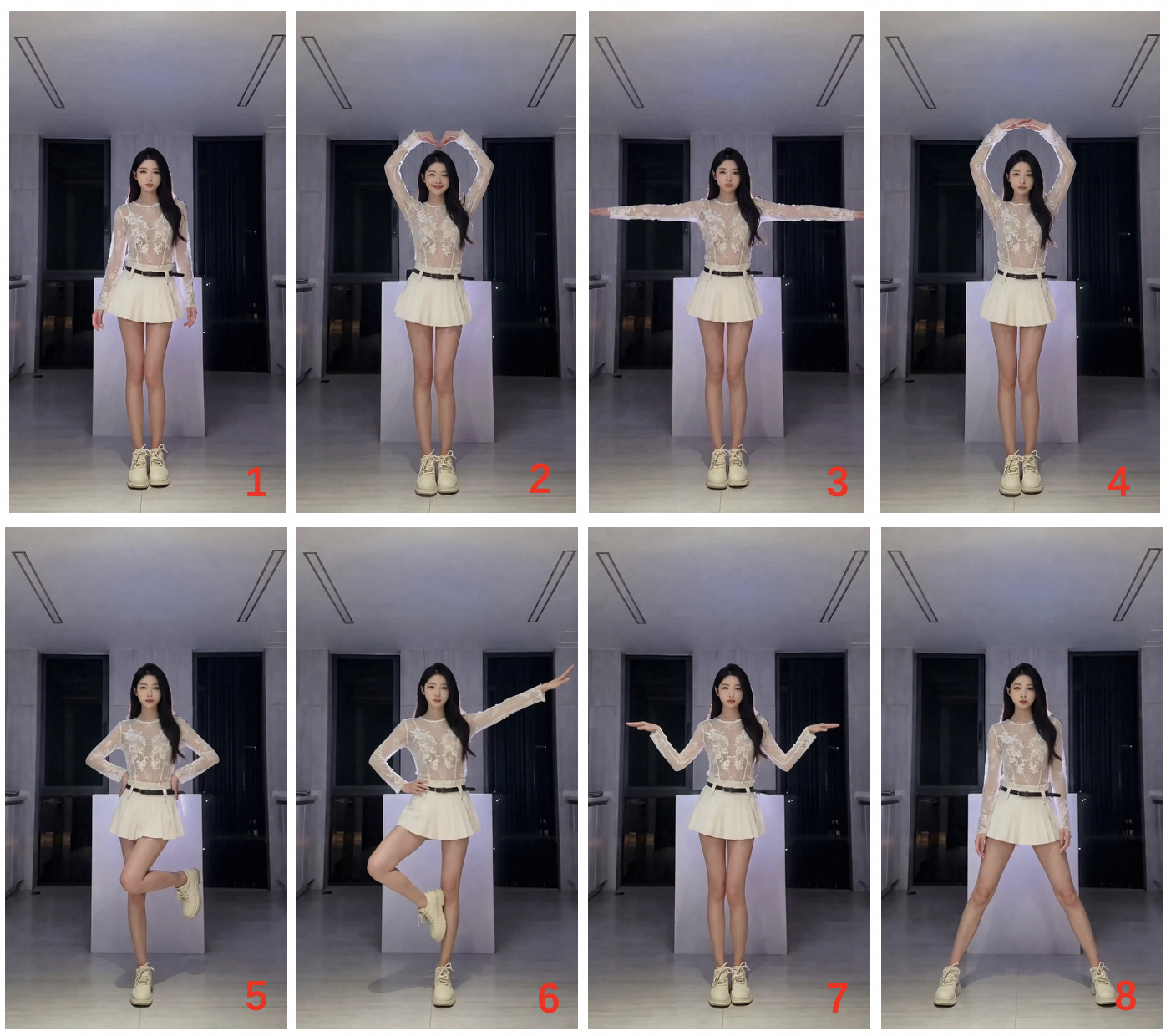
Keyframes (motion edit)
Generated result
Comparison with X-Dancer
Side-by-side qualitative comparisons against prior state-of-the-art music-to-dance methods.
Wan-Dancer vs X-Dancer
Reference · X-Dancer · Ours (combined comparison clips).
Comparison 1
Comparison 2
Comparison 3
Note: videos above were initially generated by Wan-Dancer and may include post-processing refinements, as stated on the official project page. Media is hosted by the paper authors for research demonstration.
Cite
Paper & resources
If you use Wan-Dancer in research or product work, please cite the paper.
@article{wan-dancer-2026,
  title={Wan-Dancer: A Hierarchical Framework for Minute-scale Coherent Music-to-Dance Generation},
  author={Mingyang Huang, Peng Zhang, Li Hu, Guangyuan Wang, Bang Zhang},
  website={https://humanaigc.github.io/wan-dancer-project/},
  url={https://arxiv.org/abs/2607.09581},
  year={2026}
}Ethics note
Images and music used in these demos are for research capability demonstration and are gathered from public sources or generated by AI models. If you are a copyright holder with concerns, contact the original authors via the project page.